LIS 530 (Organization of Information and Resources) Portfolio, Winter 2026)
Introductions (Individual Data Points)
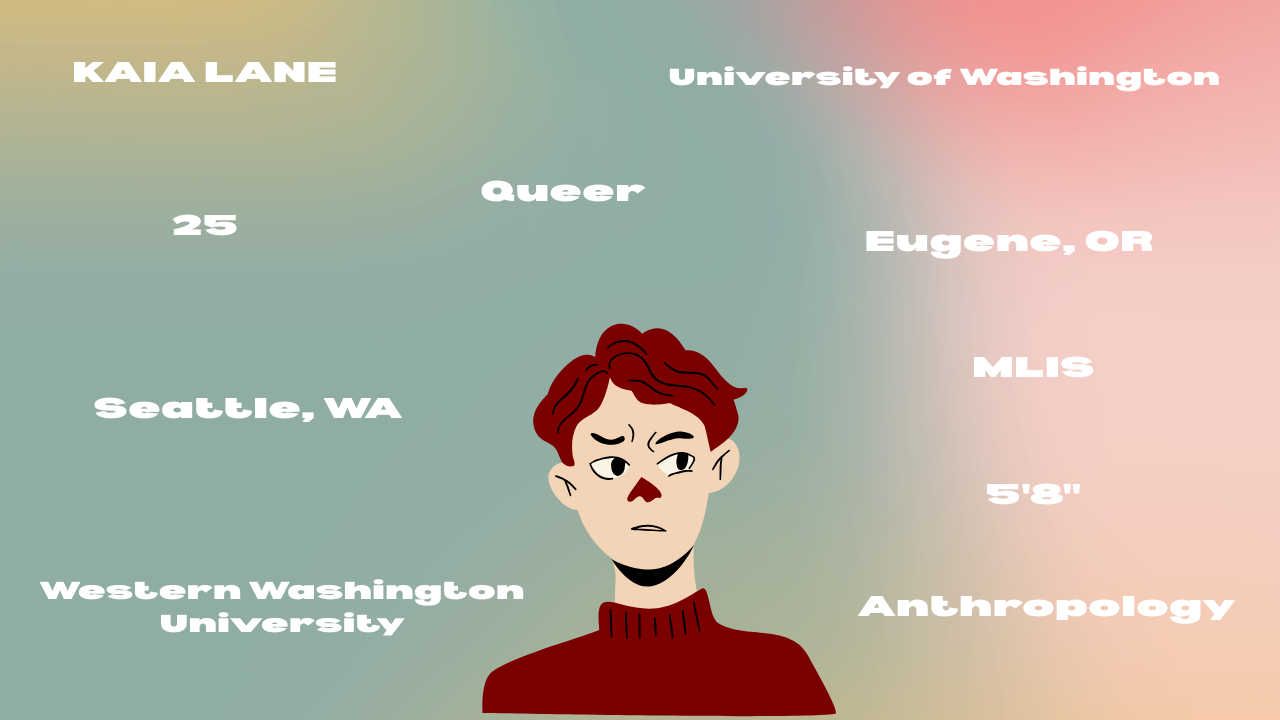
When first considering my “data points,” I started with the basics: name, age, hometown, current city, universities attended, and fields of study. These are the details I’d share when introducing myself. After listing eight data points, I added “queer” and “5'8",” bringing the total to ten. I wanted to keep my data points vague and not subject to much change. My age may shift, but the rest represent constants in how I identify myself. I chose “queer” because it is both descriptive and flexible it leaves room for me to shift my identities if I so desire, but identifies me to other people within the LGBTQ+ community. Over time, I might add new cities, degrees, or workplaces, but these core identifiers would remain.
Reflecting on my data points brought me back to my time in South Korea, where your data points are important in determining your role in a conversation. Because Korean society emphasizes hierarchy, especially in the language, people typically share name and age first to guide how they address each other. Hometown and educational background also help build connections, particularly in a large city such as Seoul. By contrast, my “queer” data point carry different weight abroad. In the U.S., I feel relatively safe disclosing personal details as I feel fairly safe in the area I live in. In South Korea, however, I probably wouldn’t divulge these kind of data points publicly since revealing “political” identities could jeopardize my visa if I were living there. As Whittaker (2019) notes, “[p]ersonal information of this nature is characteristically sensitive, as historically it has been used as the basis for discrimination and in the perpetration of violence” (p. 58). U.S. citizenship provides some legal and social protection, but Article 17 of South Korea’s Immigration Act warns that “No foreigner sojourning in the Republic of Korea shall engage in any political activity with the exception of cases provided for by this Act or other Acts” (IMMIGRATION ACT, n.d.).
Through this reflection, I’ve realized that data points are not neutral as they reveal different aspects of identity depending on context. What feels comfortable to share in one culture or community may carry risk in another. Ultimately, my data points represent both who I am and how I navigate belonging, safety, and authenticity across spaces.
IMMIGRATION ACT. (n.d.). Korea Legislation Research Institution (KLRI). Retrieved March 17, 2026, from https://elaw.klri.re.kr/eng_service/lawView.do?hseq=33079&lang=ENG
Whittaker, T. A. (2019). Chapter 4: Demographic Characteristics in Personal Name Authority Records and the Ethics of a Person-Centered Approach to Name Authority Control. In J. Sandberg (Ed.), Ethical questions in name authority control. Library Juice Press.
Changing Landscapes Using Data Nesting
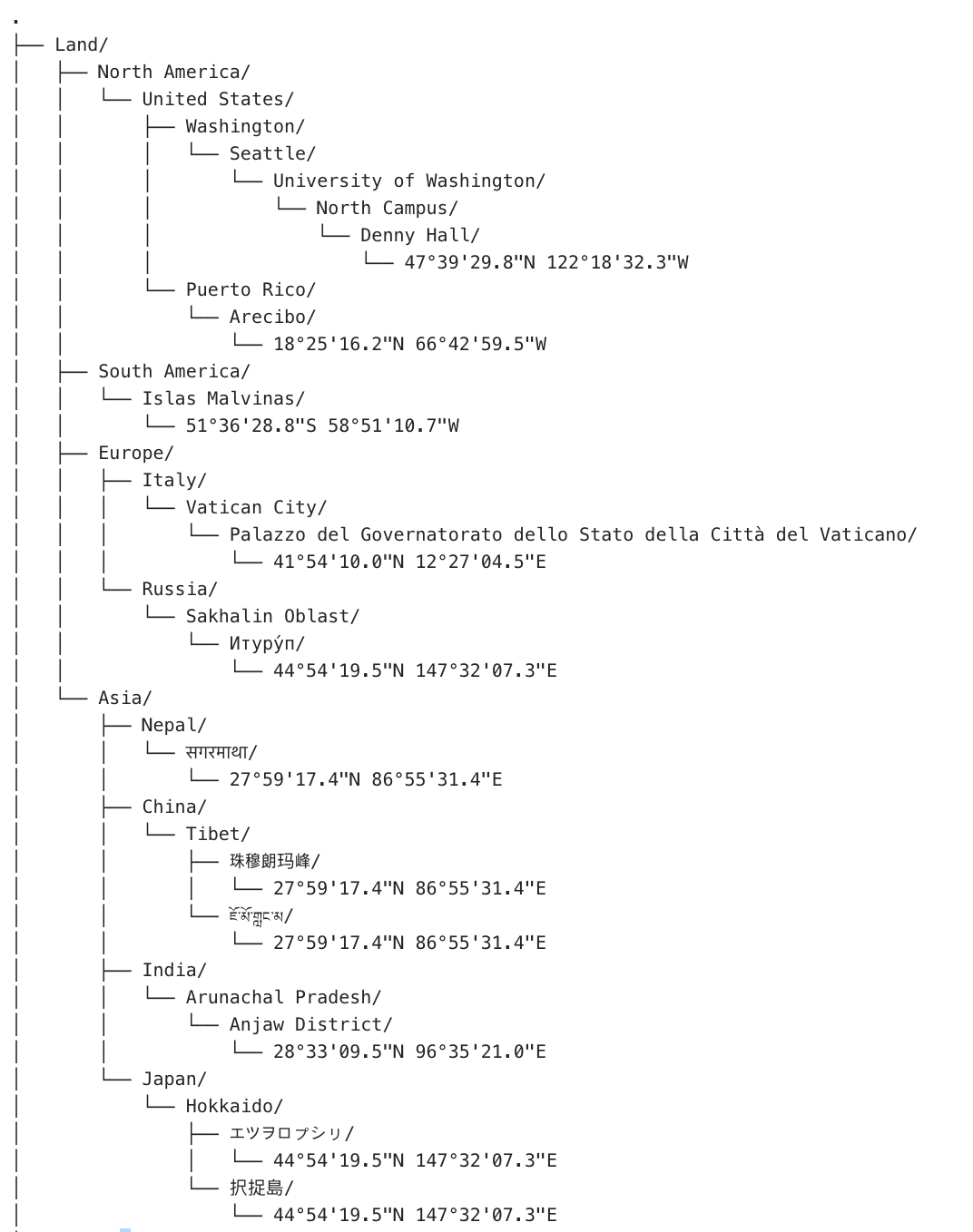
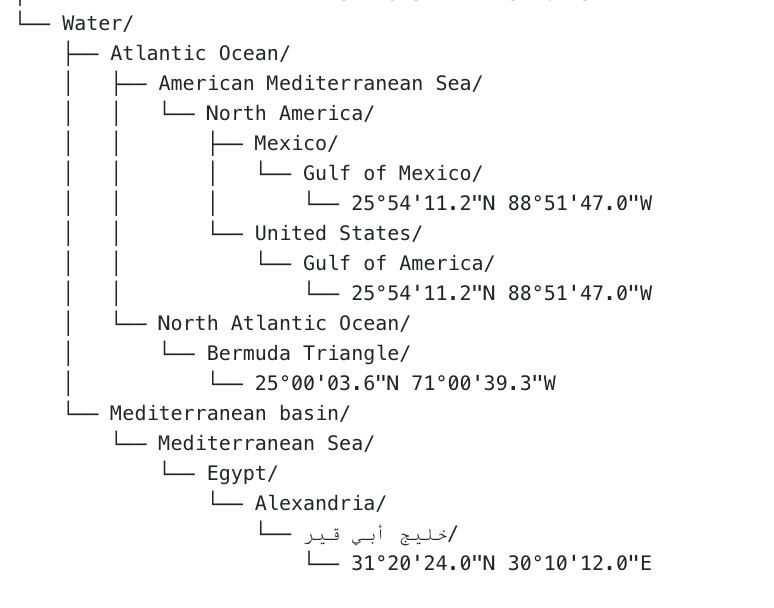
When I first started the hierarchy nesting activity, I began by using the official country that each coordinate was in or closest to, but this approach quickly felt insufficient as I continued working. I eventually shifted to two main categories: land and water. I felt by starting with these would allow me to better capture the common types of locations I would encountered. Under the land category, I usually moved from the continent level down to more specific locations. This worked well for places such as Denny Hall, but it was more difficult for sites like Mt. Everest. For places with contested ownership over the land (not the perfect term, but the most accurate one I have right now), I chose to list the coordinates in multiple locations. The most striking example of this was an island disputed between Russia and Japan: I placed it twice, once with the Russian name under Europe and once with the Japanese and Ainu names under Asia. In general, when there were contested rights over a place or region, I duplicated the entry with the name associated with each relevant country or region.
For coordinates associated with bodies of water, I often started with a non-country region and then moved into the associated countries, if that made sense. For example, with the Gulf of Mexico/Gulf of America, I listed it twice (one under Mexico and under the United States) to reflect the official and legal differences in naming and jurisdiction. The hardest coordinate to define was the one located in the middle of the Atlantic Ocean. It took me some time to decide how to categorize it, but I ultimately chose the Bermuda Triangle as the final label, since the point technically falls within that region and there were no closer, more specific landmarks that felt appropriate to use.
The names of the places was something I tried to consider throughout this activity. Hughes (2019) talks about the complications related to renaming or misnaming areas with Kurdish language names. I especially considered this with the coordinates of an island between Japan and Russia. I included the names of the island in Russian, Japanese, and Ainu. Japan is a country that people often forget that the dominant culture is the colonizing culture and that there are a lot of indigenous ethnic groups that still exist on the island. And the Ainu are one of the indigenous groups in the region (located both in Russia and Japan). My approach still lacks a lot, in part due to a lack of knowledge of some of these regions, but I think the way I approached it showed some of the complications in the official names of these places.
Overall, this activity showed me that seemingly simple questions of “where” quickly become complex once I move beyond official borders and singular labels. By experimenting with land and water categories, duplicating entries for contested regions, and acknowledging overlapping claims through multiple names, I began to see how geographic hierarchies reflect power, history, and perspective rather than neutral facts. The challenges I faced, especially with disputed territories and open-ocean coordinates, highlighted how much interpretation goes into organizing space, and how any hierarchy I create is ultimately a partial, situated way of seeing the world rather than a definitive map.
Hughes, H. K. (2019). Chapter 6: Cataloging Kurdistan: Imagining Liberated Geographies. In J. Sandberg (Ed.), Ethical questions in name authority control. Library Juice Press.
Arranging Film Collection
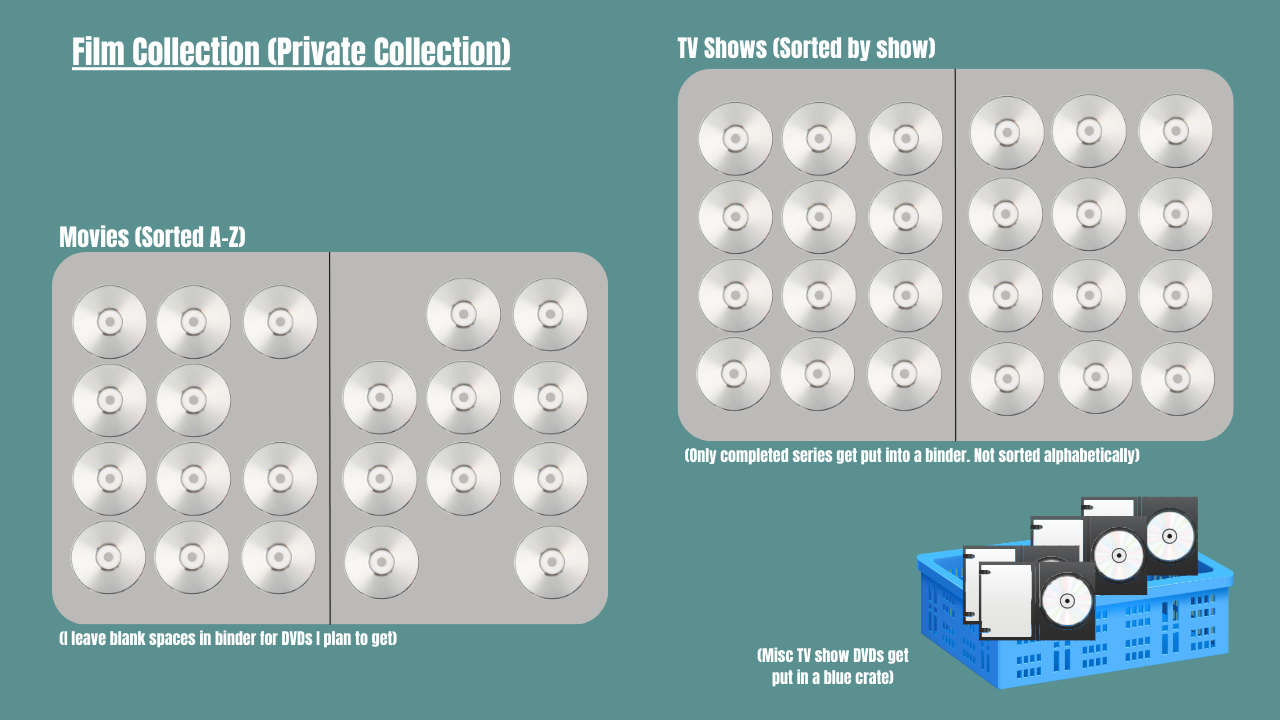
For my personal film collection, I demonstrated how I organize my DVDs at home. I store them in binders, separating movies from TV shows. My movie DVDs are alphabetized by title, but I leave empty spaces for future additions to multi-film series so I don’t have to reorganize the entire binder later. For TV show DVDs, I use both a binder and a blue crate. Completed series go into the binder since they won’t need rearranging, while incomplete series are placed in small, labeled cases and stored in the crate. The TV series in the binder aren’t alphabetized because I’m unsure which additional series or DVDs I’ll acquire, making it difficult to leave consistent space for each.
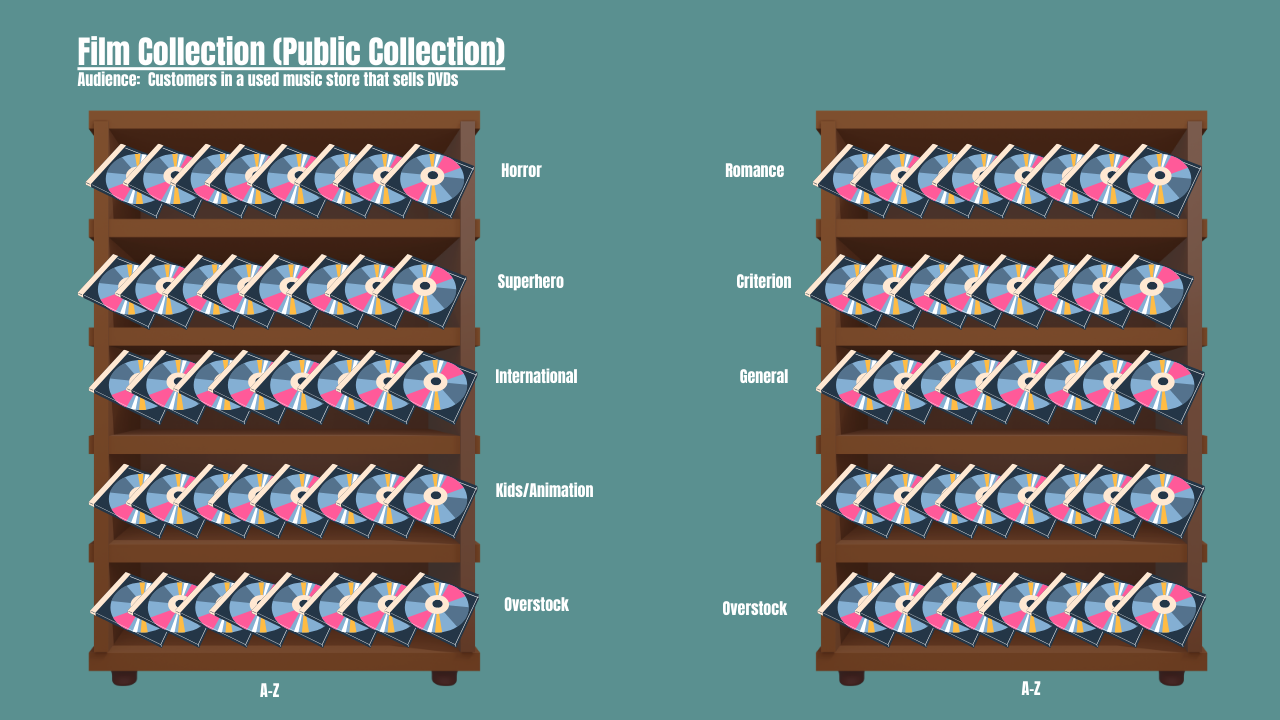
For my public collection example, for my target audience I chose adult customers at a used music and DVD store, modeled after the one I frequently visit in Seattle, WA. I imagine the DVDs arranged on tall bookshelves, separated by genres such as romance, horror, animation/kids, international, general, and Criterion. These clear divisions help customers looking for specific titles and improve overall findability. Some films may fit multiple categories, but if I have duplicates of DVDs, I could place them in different sections which could further assist customers in finding a DVD they want. Stores selling used goods have the benefit of not needing strict categorizations like big box stores and libraries as I feel like there is an expectation of the customer having to search through a lot to find something they want. There is no guarantee the store will have a certain title, so I feel like most people are just searching casually when looking at a used DVD collection in a store. Also, a lot of the time, the customer audience that go to these stores are typically collectors and enjoy the search.
What was specifically a difficult decision in my example was categorizing films as “international". I feel like it can create issues of “othering,” as Krishna (2021) notes in relation to grocery stores, but the label can also improve accessibility for diverse audiences. It helps unfamiliar viewers discover new titles and allows others to locate specific films more easily if they know the store’s layout. Finally, I would place overstock on the lower shelves—available for casual browsing but not taking up prime, eye-level space meant for featured titles.
Krishna, P. (2021, August 10). Why Do American Grocery Stores Still Have an Ethnic Aisle? The New York Times. https://www.nytimes.com/2021/08/10/dining/american-grocery-stores-ethnic-aisle.html
Designing a Dating App Data Policy and Privacy Policy

See GradMatch Privacy Policy here.
I heavily relied on Bumble Friends for crafting my privacy statement for my imaginary app GradMatch, a “dating” app that connects master’s students with similar research interests. The majority of these apps tend to be geared more towards romantic or sexual interactions, so I relied on Bumble Friends since it is one of the main apps out there for platonic matching which is the closest to my idea. It was nice to have a privacy statement to rely on for terminology because I definitely had a hard time constructing the legal structure for this type of document. Bumble definitely has a lot more information since it has things such as AI and social media connections for users, which I didn’t imagine for my app so it made mine a bit easier to construct. In Collings (2025),it talked a lot about the problems that have arisen since the introduction of AI into these apps and the consumer needs for consent and privacy statements, and I didn’t want to have the need to add more to my statement (among other things) because I decided to integrate AI in my app. It was especially helpful using a real-life privacy statement to be able to include some real-world laws such as the California Consumer Privacy Act (CCPA). Also, I saw that Bumble listed examples of service providers that they partnered with, so doing some research for my app was key. I ended up using the same marketing service providers they listed, but since I require student status verification, I did some research on one that I’ve seen other websites and apps use to be able to list in my statement. I am also sure there is a lot I am missing in my statement in regards to privacy and safety that I am not thinking of. Probably why a lot of these companies consult lawyers to craft these kinds of statements to avoid legal trouble.
Collings, P. (2025, July 21). Dating Apps Need to Learn How Consent Works. Electronic Frontier Foundation. https://www.eff.org/deeplinks/2025/07/dating-apps-need-learn-how-consent-works
Job Posting Revision
See job posting description here.
I found this job listing through archivesgig.com rather than the job boards provided for the assignment, because it is a resource I already rely on in my regular job searching and professional browsing. I use this site frequently since it is updated daily and focuses specifically on archival jobs across the world, with a strong emphasis on positions in North America, so I felt confident I would be able to locate an interesting and recent posting that aligned with my interests. When I transferred the listing into a Google Doc, I kept most of the original wording, but I adjusted the order and presentation of certain sections because a Google Doc offers different layout and formatting possibilities than a web posting, especially in terms of basic graphic design, visual hierarchy, and readability for someone scrolling through multiple documents.
The changes I made involved the description of the job’s benefits and the stated salary range. In the original listing, the benefits were primarily linked out to a separate employee benefits page, which requires an extra click and a certain level of initial interest from the applicant. In my version, I chose to pull in and list several key benefits directly in the posting itself, such as health coverage, because I think applicants who are quickly skimming multiple opportunities are more likely to pause and consider a position if they can immediately see what the employer offers beyond the base salary. I also slightly increased the salary range from what was originally advertised, as I felt the initial figure was quite low for a position that explicitly requires a master’s degree and specialized training in archives or a related field. At the same time, I did not raise it to an unrealistic level. Although I believe everyone deserves a livable wage (and ideally six figures), I also recognized that this is not a director-level role and the job is not located in a very high-cost city like New York City or Seattle, where significantly higher salaries would be necessary to match local living expenses. I also consulted a living wage calculator for the area, which states a typical annual salary for a role in the 'Education, Training & Library' category as $68,810 (Living Wage Calculator - Living Wage Calculation for Ann Arbor, MI, n.d.). So having the original salary with the high-end range still being under this average, I felt like I should increase it to account for education level, cost of living, and paying off loans.
I also incorporated an additional detail from another employee information source connected to the institution. Specifically, I highlighted that the university hosting this position was ranked as the 7th best employer in its state in 2024, a fact that did not feature prominently in the original job ad but was available elsewhere in the institution’s public-facing materials. I chose to foreground this ranking because I think it sends a strong signal to potential applicants about workplace culture, stability, and institutional reputation, and it can help distinguish this job from other postings that may offer similar pay or responsibilities but do not clearly communicate their strengths as employers. By surfacing this kind of information directly in the posting, I aimed to create a more compelling, applicant-centered description that balances honesty about the role with strategic emphasis on the aspects most likely to attract qualified candidates.
Living Wage Calculator—Living Wage Calculation for Ann Arbor, MI. (n.d.). Retrieved March 17, 2026, from https://livingwage.mit.edu/metros/11460